I. The Lovers
There is something about her laughter.
That is what he told her the night they lay, entwined, on the hill overlooking the dark lake.
“It cuts through the air like a bell, I can hear you from the apothecary when you leave the window in your studio open.”
She tried not to squirm with glee. “And that is what led you to me?”
“Yes,” he replied. “That is what led me to you.”
In moments of clarity, it’s this scene that comes back to her. It’s there in fragments – smells and tastes, mostly. The sharp citrus of wet grass. Salt and nectar on his lips. Or even in touch, the feeling of his thumb tracing circles on her palm, her head against his chest and the soft breeze of his breath on her hair. If she stays there, she remembers more. His voice. His declarations, the promises he made – promises of poetry, music, and bags of tea made from herbs and flowers that would cure her of any unhappiness she held.
She had asked him if he was happy himself. If he was content with his life.
He had said yes.
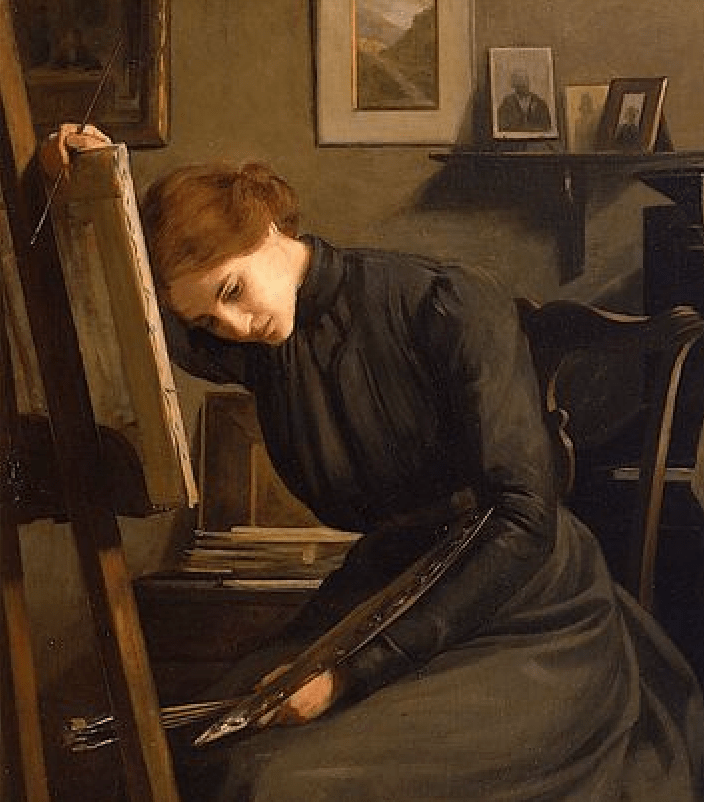
There are tears, now, blotting her apron. She lets out a gasp and pulls the brush away from the canvas. The scene is in front of her, as well as she can paint it. A blue-black background, bordered by shadows of the forested mountains. She’s tried to show the moon reflected on the lake’s water but she’s not sure she got it right – Olivier will know how to fix it. She can ask him tomorrow.
And they’re both there. They started on the rock wall – the old men say the Romans built it – but Marie had felt some semblance of joy and had jumped off of it and onto the beach.
The beach is not a beach like it is in Sicily, or Tuscany. Her bare feet slipped across the smooth pebbles until the sharp kiss of the water met her toes and she laughed as loud as she could. She heard Luca stumble onto the beach, pebbles scattering under his boots, and he said to her, “Stop it, Marie. The whole town will hear you.”
But she hadn’t painted that. Instead, they’re lying on the beach, after their conversation. Marie’s skirts are spread out and Luca takes up half of them, his right arm pulling her close to him. Her face is turned onto his shoulder. Something glistens there.
II. Judgement
They were in the studio together.
She watched as he grazed her paintings with the pads of two of his fingers. Her eyes traced the curve of his jaw, the soft caress of a strand of dark hair that slipped past his ear, the freckles sprinkled across his Italian nose.
“You are the best painter in Riva.”
She felt heat blossom across her face. “You only say that because you love me.”
He laughed. “Don’t say such foolish things.”
Marie doesn’t like the crowds that filtered onto the streets of Riva at night. Parents and their children, lifted onto shoulders or backs, bellies full from dinner; the wealthy tourists coiffed in silks and hiding their faces with fans; or the lovers, not yet holding hands (though their knuckles may brush), trailed by their anxious chaperones.
But night is the only time she was awake, and she has run out of paint.
The studio is off the main street, down an alleyway that directly faces the mountains. They rise above the streetlamps – monsters without teeth, without mouths, without eyes. But they watch her, somehow, as she picks her way across the cobblestones and towards the studio.
Like the rest of the buildings on the street, the townhouse that Olivier shares with other artists are painted in pastels. His is a light blue, similar to the alpine lakes in the north, while the apothecary where Luca works is a dusty pink.
Someone is leaving the dusty pink building. No, two people. Arm-in-arm, one wearing a dress Marie had seen in a shop window weeks ago. It is a simple green, illuminated by the light above her, which casts a warmth over the smooth texture of the dress. White bows dot the skirt and cause it to ruffle in a pattern that compliments the woman’s figure. A larger, cream-colored bow is tied at her waist.
The man wears a pharmacist’s apron.
The pair walks towards Marie. Luca spares a glance towards the painter and a flicker of recognition passes through his eyes, but he says nothing. They continue on. Marie cannot understand what they say, though she strains to listen. They are speaking Neapolitan, the language of the region where Luca was born, of which Marie knows nothing. She is barely fluent in Lombard.
She stares after them. They turn onto the main road, in the direction of the lake. Marie takes a few steps back until she is leaning against the door to Olivier’s townhouse and she sinks to the ground. There are no tears, just open eyes – frozen on the spot at the end of the road where she had seen the woman pull Luca’s cheek towards her lips.
III. The Hermit
The dress took up the entire window.
Behind it, in the boutique itself, young girls shopping with their mothers couldn’t help but stare. They were too young for it, but their eyes would remember every detail.
She stood in front of the dress, a pouch of coins in her palm, trying to count how much she had without opening it. Only one of her paintings had sold at the last open gallery, and her allowance hadn’t come through from Olivier. If she bought it, she wouldn’t be able to afford rent.
He was standing next to her. “A good choice,” he said as she shoved her pouch back into her apron. “You shouldn’t waste your money on such fickle things.”
Olivier lets her sleep in his bed the next day. It is late spring, and the window to his bedroom has been flung open to allow the breeze in, bringing the scent of coffee grounds and baking bread.
Marie pulls the covers over her head and tries to block out as much as she can, but the sounds of the Saturday market won’t let her rest. When she sits up in the bed, she feels the nausea of last night return and she stumbles to the closet where a chamber pot is kept.
She’s not sure why she’s sick – all she knows is that the memory of that woman’s lips on Luca’s cheek makes her stomach broil and her head split. The smell of her sick curdles her appetite even further. She cannot remain in this room.
Only a few hours of sleep in her, she descends the stairs to her half-brother’s studio.
He is singing in their native French. Marie interrupts, “’Belle qui tiens ma vie’?”
Olivier glances over at her and curls his lips in a wry smile. “Yes, Pear. You remember.”
The familiarity of her brother’s French tongue eases her stomach. “Maman used to sing it to us. Didn’t she perform it, as well?”
He looks surprised. “You were so young when she was still performing. I wasn’t sure if you’d remember.”
“Of course I do.” Marie sits on one of the stools next to Olivier’s easel and stares at his painting. A landscape of the lake, similar to the painting of her and Luca she had finished the other day. It’s better than hers, of course. Everything he does is better than her. It’s always been that way. Any other day, she would have gotten angry at him.
Today, she cries.
Olivier puts his brush down and gathers her into his arms. He is barely taller than her, although a decade older, but his grasp is strong.
The words rush out, tears mixing with spit as everything stumbles together. Why couldn’t he love her? What held him back, what kept him away, what didn’t she have that he needed?
“Olivier, I would do anything,” she sobs. “If he would just tell me what was missing or what I did wrong, I would correct it in an instant. I would do anything for him, just to have him back.”
He remains quiet as she breaks down. Her tears stain his smock and yet he holds her more tightly, as if trying to squeeze every last bit of sadness out of her.
When Marie’s sobs turn to hiccups, Olivier pulls away and forces her to look him in the eyes, asking, “Is this really about the boy?”
Her eyes widen in shock. After a few shuddering breaths, she replies, “What do you mean?”
Olivier brings over another stool and sits on it, facing Marie. “You are an artist, little Pear. You are like me. You seek out people and feelings and experiences so that you know what to paint and how to feel when you paint. I would never blame you for this, but I do wonder if you are holding on to these feelings, subconsciously, so that you can pour it into your paintings.”
Marie begins to protest, but her brother holds up a hand to stop her. “You are worried that you have lost your touch,” he says. “But you are so young. You are at the beginning of your life, learning what it means to live in this world. You can’t lose something that you do not yet have.”
IV. Death
“I’ll never be able to love you in the way that you love me.”
He was standing in front of her. Her eyes were fixed on the sculpted hedges. A gardener walked amongst them, a pair of shears dangling from the belt around his waist.
“I think I’ve always known, really, that it would turn out this way.” He had begun to pace in front of her. “We are too different, and I must look for someone who complements me.”
The chrysanthemums were looking particularly beautiful that day.
The money Marie and Olivier’s mother had left them was enough to afford a casual living for the rest of their lives. Olivier held most of it in the bank, but would give Marie a portion every month for her rent and smaller things, like nice dresses and hobbies outside of painting.
One of those hobbies was sailing.
It was a hobby mostly reserved for men, but the boat hire knew Olivier well and would turn a blind eye if Marie put her long, curly hair into a cap.
Riva is warm on the shore this time of year, but on the lake a wind with the bite of snow blows from the mountains. Marie tacks and jibes, following the cold wind into the middle of the lake. No one else is on the water, so she brings the sail down and lies back on the thwart.
She has never been a fan of cloud-watching. Clouds are difficult to paint, no matter what medium she uses. Things that she could paint well puts her mind at ease. She can smell the tangy scent of the oils, feel the slice of the brush against the canvas. The mountains and the buildings are her favorites; standing still as the world moves around them.
But clouds are fickle. Forever changing, moving apart and collecting together. Perhaps if she uses a rounded brush instead of a straight one – she closes her eyes and there’s an easel in front of her – if she mixes white with a drop of dark blue for the outline of each layer, then fills in the rest with pure white, maybe it would look right. She can see it in front of her, painted in the sky above.
Even as the clouds change, their imprint in her mind remains.
V. The Star
They saw each other on the beach, one night.
“I’m engaged. We leave for Naples in the winter.”
She stared at him. She still admired his dark hair, his Italian nose. He was beautiful – clean lines and rounded eyes. She had been so happy to be cared for by someone like him. Someone that looked like him.
She smiled in response. “Naples is beautiful. Will you be happy to be home?”
He met her eyes and replied, “I believe so. A part of my heart has always been there.” A pause. “As it will be here.”
“Ah, like mine is in France.”
“Yes.” But his gaze had not left hers. “Would you visit me? Rail travel has become so much easier. Perhaps I could commission a painting for our house?”
There was a pause as she took in his words.
Then she laughed.

 A. C. Rosenfeld
Leave a comment